

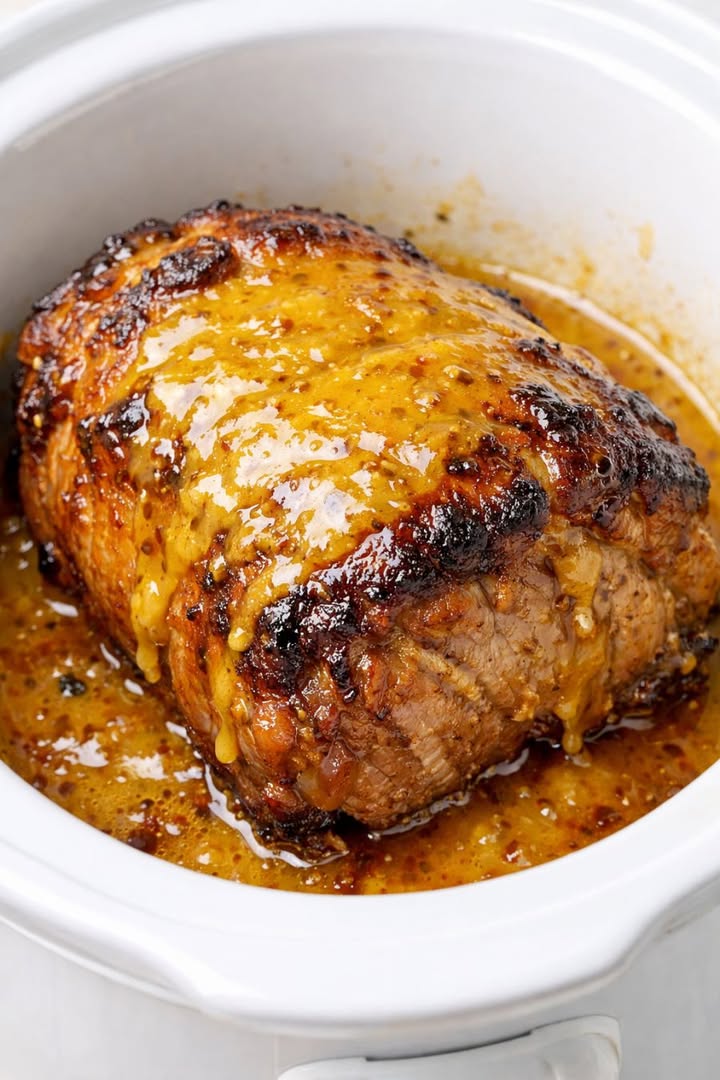
Slow Cooker Honey Mustard Pork Roast
Honey and mustard together is one of the most reliable flavor combinations available for pork — the honey’s floral sweetness balances the mustard’s sharp, tangy complexity, and the two together create a glaze that caramelizes beautifully over the surface of the roast during the long, slow braise, producing a golden, slightly sticky sauce that looks considerably more involved than its three-ingredient composition suggests. This slow cooker version keeps everything as simple as the sauce: pork shoulder or loin roast, honey, Dijon mustard, and salt. Seven to nine hours on LOW and the roast is completely tender, surrounded by a glossy honey mustard sauce that’s worth spooning generously over every slice.
The choice between pork shoulder and pork loin for this recipe produces meaningfully different results, and understanding the difference helps in choosing the right one for your purposes. Pork shoulder is the more forgiving, more richly flavored option — its fat and connective tissue break down during the long slow cook into collagen-rich gelatin that contributes body to the sauce and keeps the meat moist and tender through the full cooking time. Pork loin is leaner and produces a more elegant, sliceable roast, but it’s more sensitive to extended cooking and can dry out if the cook runs long. Both are excellent; the shoulder is recommended for the most reliably succulent result.
Why Honey and Mustard Work So Well Together
The honey-mustard combination has endured as a sauce and glaze for good reason: the two ingredients work on each other in ways that produce a result greater than either alone. Honey’s sweetness is straightforward — it adds sugar — but it also brings a floral, slightly fruity complexity and a viscosity that helps the sauce cling to the meat’s surface during the long braise. Dijon mustard’s sharpness comes from the glucosinolates in the mustard seeds and the acidity of the wine that’s part of its preparation, and that sharpness provides the contrast that keeps the honey from tasting cloying. The mustard also acts as an emulsifier, helping the sauce maintain a consistent, unified texture as the roast’s juices are added to it during cooking.
Over the course of seven to nine hours in the slow cooker, these flavors evolve. The honey caramelizes, developing a deeper, more complex sweetness; the mustard’s sharpness mellows and rounds; and the pork’s rendered fat and released juices enrich the sauce, adding savory depth that the original three-ingredient mixture doesn’t have on its own. The result is a braising liquid that tastes like something that took much longer to build than it actually did.
Why You’ll Love This Recipe
Four ingredients and a slow cooker, with a prep time of under ten minutes. The sauce is made by whisking three pantry ingredients together in a small bowl — there’s no cooking, no separate pan, nothing to clean beyond the bowl and whisk. The pork roast goes in the slow cooker raw, the sauce is poured over, and the whole thing is left alone for the better part of a day. The result is a complete, impressive-looking main course with a glossy golden sauce that makes it look as if considerably more work was involved.
The dish works as well for a casual family dinner as it does for entertaining — the pork holds beautifully on the WARM setting for an hour or more, making it practical for gatherings where dinner timing is flexible. Leftovers are excellent in sandwiches or wraps the next day, particularly with a smear of additional Dijon and some crunchy coleslaw alongside the shredded pork.
Ingredient Notes
Boneless pork shoulder or pork loin roast — 3 to 4 pounds — is the protein. See the introduction for the key differences between the two. For the most reliably tender, moisture-retaining result, pork shoulder (also sold as pork butt or Boston butt) is the better choice — it’s designed for the low-and-slow cooking method and can comfortably handle the full 7 to 9 hours on LOW without drying out. Pork loin produces a leaner, more refined presentation and is good for shorter cooking windows; check it at the lower end of the time range (6 to 7 hours on LOW) and remove it as soon as it’s tender to prevent over-cooking and drying. Trim excess external fat but leave some fat coverage on the surface if there’s a fat cap — position the roast fat side up so the rendering fat bastes the meat throughout the cook.
Honey — half a cup — is the primary sweetener and one of the two defining flavors of the sauce. A good-quality honey makes a perceptible difference in the finished dish — raw or minimally processed honey has more complex floral and fruity notes than heavily processed varieties, and those nuances carry through to the finished sauce. Clover honey is the most neutral and widely available option and produces an excellent result; wildflower, orange blossom, or buckwheat honey each shift the sauce’s character slightly with their own flavor profiles. Buckwheat honey is particularly good with pork for its deeper, more molasses-like character.
Dijon mustard — half a cup — provides the sharpness, complexity, and emulsifying quality that balances the honey and gives the sauce its layered character. A full half cup is a generous amount relative to the honey, producing a sauce where the mustard is clearly present as an equal partner rather than a background note. This balance is what makes the sauce interesting — less mustard produces a sweeter, less complex result. For a variation, whole-grain Dijon (sometimes sold as “country-style” mustard) adds visible mustard seeds that create an appealing rustic texture in the finished sauce. Yellow mustard can be substituted for a milder, more familiar flavor that some people prefer, particularly children — it produces a sauce that’s sweeter and less complex but still very good.
Kosher salt — 1½ to 2 teaspoons — seasons the sauce and, by extension, the meat. The amount specified is calibrated for the quantity of meat and sauce in this recipe; adjust slightly if using a significantly smaller or larger roast. Taste the honey mustard mixture after whisking and before adding it to the pork — it should taste pleasantly salty and sweet in balance, not bland. Salt that goes into the sauce at this stage permeates the entire roast during the long cook, seasoning the meat from the surface inward in a way that salting after cooking cannot replicate.
Ingredients
3 to 4 lb boneless pork shoulder or pork loin roast, trimmed of excess fat
½ cup honey
½ cup Dijon mustard (or yellow mustard for a milder flavor)
1½ to 2 tsp kosher salt
see continuation on next page
To see the full cooking instructions, go to the next page or click the Open button (>) and don't forget to SHARE it with your friends on Facebook.