
They said I’d never get married. Twelve men in four years looked at the wheelchair and walked away.
My name is Elisabeth Wetmore, and this is the story of my journey from social rejection to the discovery of a passionate love that changed the course of history.
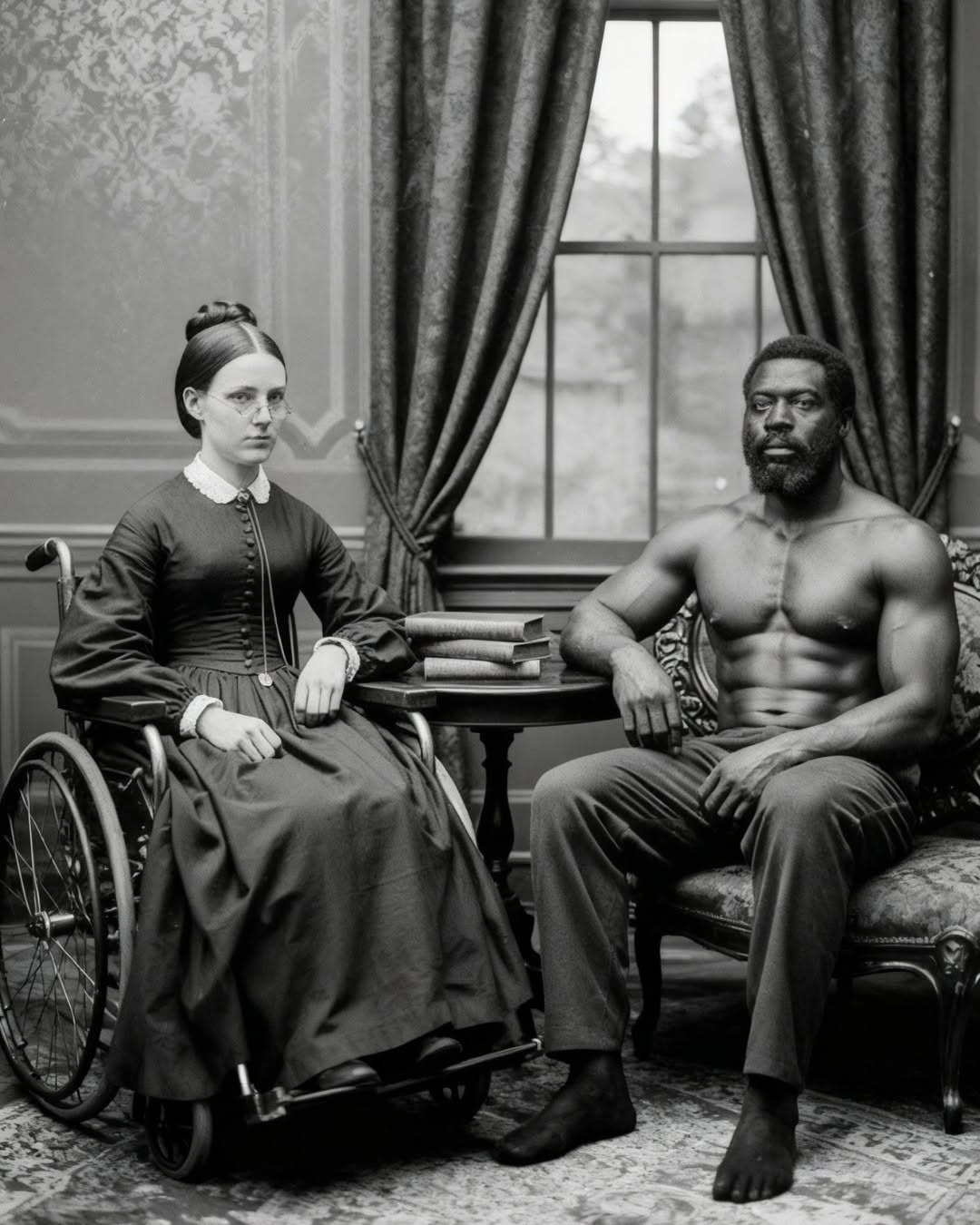
Virginia, 1856. I was twenty-two years old and considered myself disabled.
I lost the use of my legs at the age of eight, after a fall from a horse that broke my spine, forcing me to use this mahogany wheelchair my father had ordered for me.
But no one understood that it wasn’t the wheelchair that made me “unmarriageable,” but what it represented: a burden.
A woman who can’t be with her husband at parties, a woman who shouldn’t have children, who can’t manage a household and, at the same time, fulfill all the duties expected of a Southern wife.
The twelve proposals my father developed ended with the same number of rejections, each more difficult than the last.
“She can’t walk down the aisle.” “My kids need a mother to chase them.” “So what if you can’t have kids?” This latest rumor, completely false, has spread like wildfire through the Virginia community.
Doctors speculate about my fertility, even though I’d been tested. Suddenly, I wasn’t just a disabled person, but a disabled person in every sense, which was important in 1856 America.
When William Foster, a fat, drunken fifteen-year-old, rejected me despite my father offering him a third of our annual inheritance, I knew the truth: I would die alone.
But my father had other plans. Radical, shocking, and completely outside the bounds of social convention, so much so that when he told me, I thought I’d misunderstood him. He said, “You will marry Josiah, the blacksmith. You will be his wife.”
I looked at my father, Colonel Richard Whittemore, owner of 5,000 acres of land and 200 slaves, and was sure he was crazy.
First, let me tell you about Josiah. I called him “the monster.” He was eight feet tall and weighed 300 pounds of rock-solid muscle, sculpted from years of hard labor in the forge.
His hands could bend iron bars, and his face struck terror into anyone who entered the room. People feared him, slaves and free men alike.
The white boys on our farm would stare at him and whisper, “Did you see how big that man is?” And Timor has a monster in his forge.
But here’s what no one knew, what I was about to discover: Josiah was the kindest man I knew.
My father summoned me to his office in March, 1856, a month after Foster’s refusal and a month after I had given up all hope of being left alone.
see continuation on next page
To see the full cooking instructions, go to the next page or click the Open button (>) and don't forget to SHARE it with your friends on Facebook.